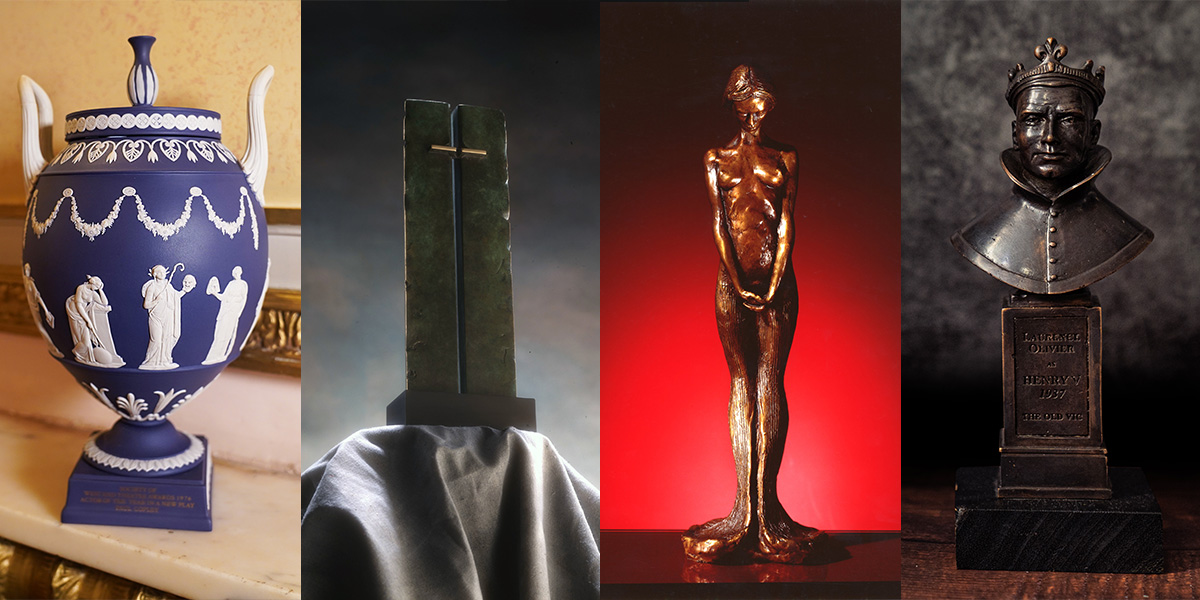
Olivier Awards: Evolution of a trophy
When the awards were inaugurated as the Society of West End Theatre Awards, winners received a specially commissioned blue Wedgwood urn. Affectionately known as the “Urnie”, the blue jasperware urn measured 31 cm high and 13.5 cm wide and featured a portrait of the actor David Garrick and actress Sarah Siddons within moulded oval frames, surrounded by swags of flowers.
A 1978 Actor of the Year in a Supporting Role Urnie, awarded to Robert Eddison for his performance as Feste in Prospect Theatre Company’s production of Twelfth Night at the Old Vic and on tour, can be viewed at the V&A East Storehouse’s through their Order an Object service.
From 1979, winners received a bronze figure inspired by a performer acknowledging an audience’s applause. It was created by Tom Merrifield, who became a sculptor after a distinguished career as a dancer, performing on the West End stage throughout the ’50s, ’60s and ’70s in musicals such as On The Town, West Side Story and Show Boat.
In 1985, Ann Christopher – then the youngest female sculptor elected to the Royal Academy – was commissioned to create a new statuette for the Olivier Awards. During its tenure, this trophy was presented to performers including Anthony Sher, Patti LuPone, Robert Lindsay, Michael Crawford, Lesley Mackie, Albert Finney, Lindsay Duncan, Michael Gambon and Judi Dench.
Dench’s wins in 1977, 1980, 1987 and 2016 (among her eight Olivier Awards in total) mean that she has received every version of the statuette.
Following the renaming of the awards in honour of actor Sir Laurence Olivier, the iconic “Larry” statuette that we know and love today was introduced in 1988. Designed by Harry Franchetti, it depicts a young Laurence Olivier as Henry V at the Old Vic in 1937 and, despite some small tweaks, has remained much the same ever since! Cast from bronze and weighing in at 1.6kg, the Larry takes five days to make.