Now in its 39th year, the bursary scheme was established in 1987 to celebrate Laurence Olivier’s 80th birthday and continues to champion the next generation of acting talent. It is awarded to students who demonstrate extraordinary promise but face financial barriers to complete their training.
In addition to the Theatre Development Trust, this year’s bursaries were made possible by the generous support of the Estate of Sir Peter and Lady Saunders, The Clothworkers’ Foundation, the estate of Carmen Silvera (via Barry Burnett), and The Casting Directors’ Guild.
Past recipients include some of the UK’s most celebrated performers, such as Michaela Coel, Denise Gough, Paterson Joseph, Ewan McGregor, and Michael Sheen.
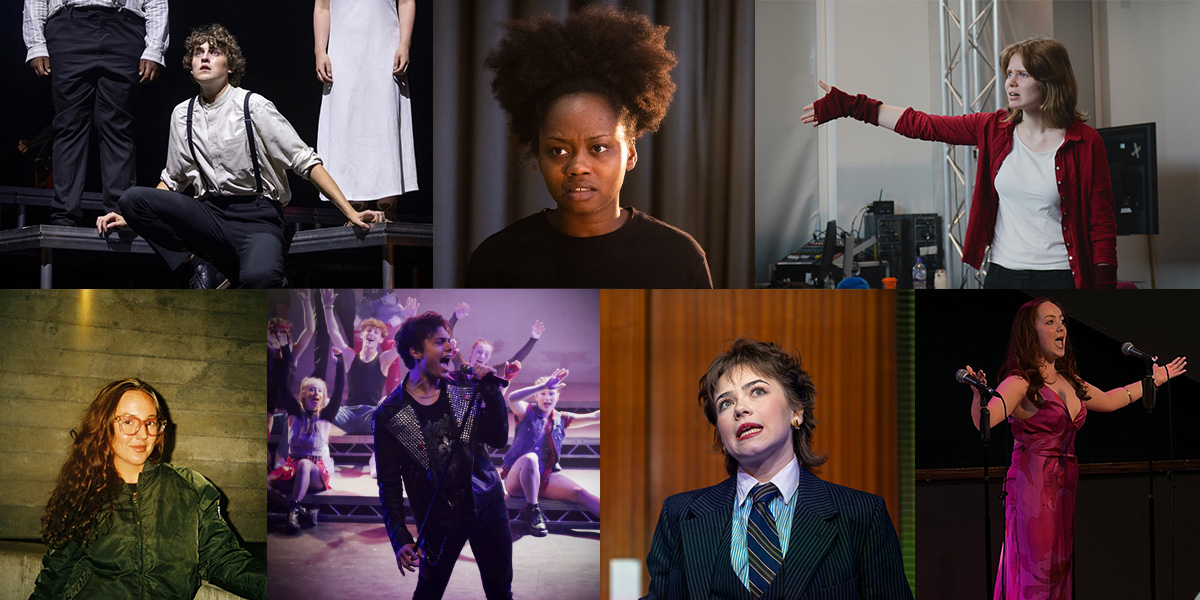
We asked our 2026 Recipients to tell us about themselves and their thoughts on their future careers within theatre.
2026 Laurence Olivier Bursary Recipients: Bonnie Lowden, Charlotte Jameson, Finley Miller, Jay Gherie, Annie McGinn, Jack Wright, Jola Olajide, Phoebe Douglas, Asante Finlay.
What’s Your Dream Role And Why?
Jola Olajide: My absolute dream role would be something supernatural but gritty, and rooted in a very contemporary setting, along the lines of E4’s Misfits. I really enjoy science fiction as a genre, especially if it’s a comedy, and it’s even better when it’s set in the present day or not-too-distant future because it encourages the audience to make the unbelievable believable. It’s a great challenge on the actor too to have to find truth in circumstances that are quite literally out of this world.
Charlotte Edwards: My dream role has always been Lady Macbeth. I am a massive Shakespeare fan and my all-time favourite play has got to be Macbeth. Lady M is such a rich, ruthless and complex female character with so many layers – it would be so much fun to delve into it all. My favourite Lady Macbeths I’ve seen recently have been Indira Varma’s and Cush Jumbo’s – they were outstanding!
Phoebe Douglas: Blanche (A Street Car Named Desire) I would love to explore her rawness and reliance on the fantastical to survive. Harper (Angels In America) I’m curious about the total loneliness of her soul and again, the wonder of the imaginary to survive.
What Do You See As Being Most Important To The Future Of The Theatre Industry?
Bonnie Lowden: Realising that no AI has had the true rollercoaster experience of being a human. Human emotions cannot be generated by code, they are raw, impulsive and illogical, the opposite traits of a computer. No script created by AI could ever come close to the honesty and vulnerability of a script written by a human. We need to protect playwrights and writers for screen, nothing in the industry would happen without them.
Jola Olajide: We desperately need a consistent push of untold and hidden stories for the future of our industry. Global politics has taken a more divisive and exclusionary turn and our industry is heavily impacted by this. The arts are continuously being defunded and drama has been cut from many school curriculums. The more conservative the world becomes, the less diverse productions are produced. The works that then do make it past all the red tape have to be ‘safe’ so as to not provoke audiences and disturb profits. That leads to less stories for and about queer identities, people of the global majority and people with disabilities. It is so important to keep championing these stories as they were often the ones that spoke to me as a young Black actor and could speak to the next generations.
Charlotte Edwards: Making ‘world-leading training’ accessible to everybody. Degrees in theatre arts are extremely competitive and expensive – we need more opportunities for those wanting to pursue a career in theatre. With the arts facing constant funding cuts within schools, young aspiring actors seek extracurricular clubs and classes – but not all can afford them. Because of this there are stories out there that aren’t being heard. Every young actor, regardless of background, should have the opportunity to advance without these barriers standing in their way.
What Made You Want To Pursue Acting?
Annie McGinn: I wanted to pursue acting for the ability and privilege of being able to tell other people’s stories! Working as a carer, I was constantly exposed to a wide variety of stories, ways of living and constantly experimenting with different forms of communication. From such a young age, I loved research and finding things out and when I got older and I started drama lessons I was set. For me, the performing arts is such a unique form of communication and expression that I am so grateful to be a part of and pursue. I also want to be someone in the industry for other people like me to look up to! To represent working class, queer scousers who graft away at making their dreams happen is something I strive to hold with me throughout my career.
Phoebe Douglas: I loved reading when I was younger and making up scenarios in my head. I started going to the theatre a lot and saw Kneehigh’s Dead Dog In A Suitcase at home in Cornwall and it blew my mind, from there I thought ‘wow this is what I want to do’.
Bonnie Lowden: The idea that as one person, you can tell the stories of so many people. The ability to share the topical and important lived experience of characters is something really special to me and something I believe is very needed in the modern age.
What Does Receiving This Bursary Mean To You?
Jack Wright: I was honoured to receive the Laurence Olivier bursary. The bursary is not only a prestigious achievement, but it is a financial lifeline. Staying afloat financially throughout my training was my biggest burden, the bursary has lifted this pressure, allowing me to fully embrace my final year of training.
Finley Miller: Receiving this bursary has completely transformed my drama school experience. From a northern boy who always dreamed of performing, opportunities like this felt so out of reach. This support has given me the chance to slow down and fully enjoy my final year at drama school, as well as my introduction to the industry, without the constant pressure of having to work multiple jobs just to stay in London. It is a huge honour to represent such an incredible organisation.
Charlotte Edwards: I feel incredibly grateful to receive such an amazing award. This bursary will have a huge impact on my final year, allowing me to focus fully on my training and lift financial pressure off my shoulders. To have even been put forward for this award is an honour in and of itself, let alone to receive it. BOVTS has done so much for me over these last two years and it’s a privilege to represent their brilliant teaching with this opportunity. I’m feeling very excited for the year ahead!
What’s The Best Advice Someone Has Given You Within The Industry So Far?
Finley Miller: A teacher once told me that in this industry ‘you never stop learning’, and that is something I connect with deeply. I believe there is always a new experience and something new to learn and grow from. Whether it’s stepping into a character who feels completely different from yourself or collaborating with a new creative team, there is always room to grow. Theatre is constantly evolving, and I believe we should evolve alongside it rather than remain stagnant in our craft.
Jack Wright: I’ve been told that preparation is key. This has become more evident now as I approach third year. It’s so important to be disciplined. Conscious preparation informs and nourishes unconscious acting decisions.
Annie McGinn: A teacher once told me that practice is about creating new habits through repetition, to create a sense of familiarity for the body to rely on. My mindset with regards to ‘failure’ has often limited me – if I wasn’t getting something ‘right’ then I wasn’t doing a good job. But changing the nature of my practice to revolve around curiosity – alongside setting specific goals to meet and being efficient with my time – is something I will carry on into my career. What I do know is that developing resilience through ‘failure’ has completely changed my perspective with regards to what I thought possible in my career and allows a constant sense of play and fun throughout the variety of disciplines that musical theatre has to offer.
Bonnie Lowden: You are the foundation of your characters, build the character off things you’ve lived, observed and desired before adding on the nuance.
We look forward to seeing where these talented individuals go next.